

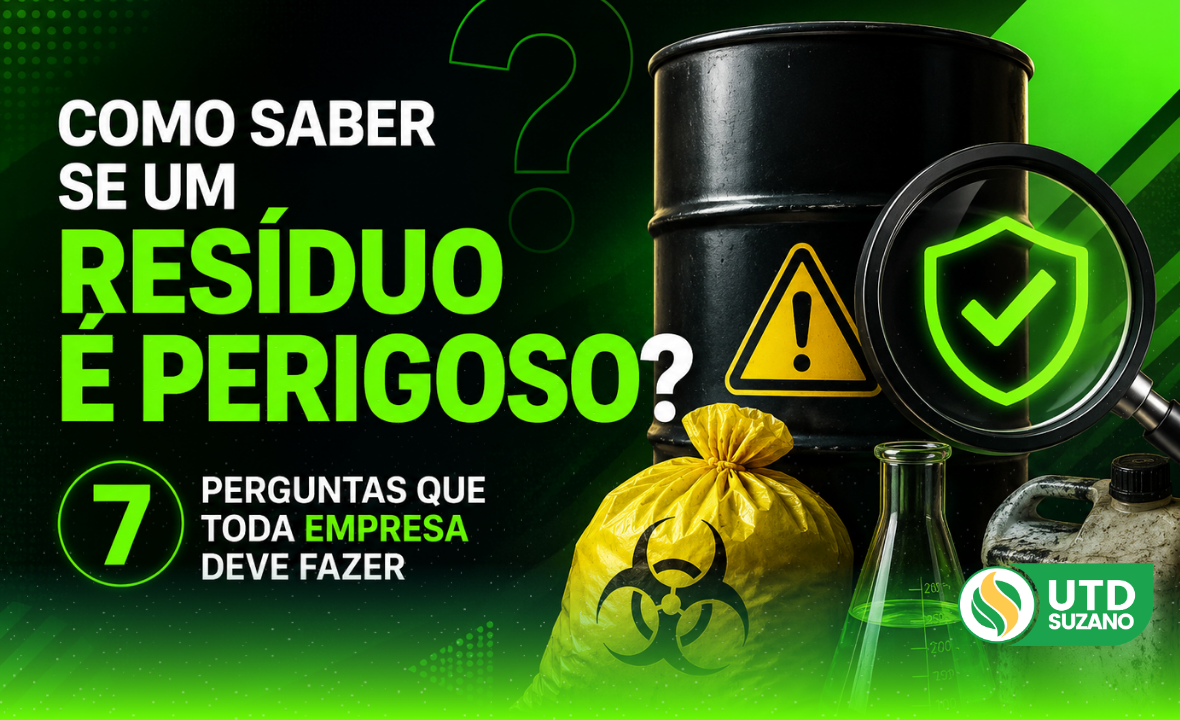
Knowing exactly what waste a company generates is essential to ensure proper storage, transport, treatment, and disposal. But how can you tell if a given material poses a risk?
The answer isn’t found in the waste’s appearance alone. Classification depends on its characteristics, composition, origin, and potential to cause harm to human health or the environment. That’s why, before deciding on proper disposal, a few questions need to be answered.
1. Where did this waste come from?
The first question concerns the waste’s origin. The process that generated a given material can provide important information about its composition and possible risks.
Waste from industrial processes, laboratories, healthcare services, workshops, chemical activities, or other segments can have different characteristics, even when they look similar.
Knowing the origin helps identify which substances may be present and which criteria need to be assessed during classification.
2. What is in the waste’s composition?
Knowing which materials and substances are present is one of the most important steps.
Chemical products, metals, solvents, medications, contaminated materials, and other substances can give the waste hazardous characteristics.
That’s why information about raw materials, products used in the process, and possible contaminants must be part of the assessment. ABNT NBR 10004:2024 establishes requirements for classifying waste hazard levels.
3. Does it show any hazardous characteristics?
Waste can be considered hazardous when it has properties capable of posing risks to health or the environment.
The criteria evaluated include flammability, corrosivity, reactivity, toxicity, and pathogenicity. The 2024 version also reinforces the assessment of hazardous substances, including Persistent Organic Pollutants (POPs).
This means that a seemingly ordinary material may require special care once its physicochemical or infectious characteristics are analyzed.
4. Is any hazardous substance involved?
Another important point is checking whether the waste contains substances that could give the material hazardous properties.
This analysis may involve technical information about the products used, such as safety data sheets, chemical composition, and characteristics of the inputs involved in the process.
Here’s a point worth noting: it isn’t safe to classify waste based solely on experience or appearance. The assessment must take into account technical information and the criteria set out in applicable standards.
5. Is it necessary to carry out analyses or tests?
Visual or documentary assessment isn’t always enough.
Depending on the waste and the information available, sampling procedures, laboratory analyses, and specific tests may be required to determine its characteristics.
ABNT NBR 10004 itself establishes requirements for the classification process, while complementary standards can be used for procedures related to characterization.
That’s why, whenever there’s doubt about classification, seeking technical support is much safer than assuming the waste is non-hazardous.
6. Is the company storing this waste correctly?
After identifying a possible risk, it’s necessary to look inward at the company itself.
Where is the waste stored? How is it labeled? Is there a risk of leakage, contact, reaction, or contamination?
Classification shouldn’t be seen merely as a documentation requirement. It directly influences packaging, storage, transport, treatment, and disposal conditions.
Incorrect classification can increase operational and environmental risks, in addition to creating compliance issues for the company.
7. Is the chosen disposal method really appropriate?
Finally, perhaps the most important question: what will happen to this waste after it leaves the company?
Identifying hazard level is just one step in management. It’s necessary to ensure the material is sent to a solution compatible with its characteristics and with applicable environmental requirements.
The National Solid Waste Policy establishes responsibilities for generators and reinforces the need for proper waste management.
8. Bonus: Count on specialized support
If your company still has doubts about the classification or disposal of the waste it generates, UTD Suzano can help with this process. Our team offers support in identifying waste and finding the most suitable solutions for each type of material.
In addition, we carry out the collection, treatment, and final disposal of waste, providing integrated and secure management, from removal all the way to proper disposal. This way, your company benefits from more convenience, control, and safety at every stage of waste management.
Classifying correctly is the first step
Determining whether waste is hazardous shouldn’t be based on assumptions. The assessment must take into account origin, composition, hazard characteristics, and the technical criteria set by current standards.
With the 2024 update to ABNT NBR 10004, the classification process gained a more up-to-date structure aligned with international criteria. That’s why keeping internal procedures up to date is also part of responsible management.
For companies that generate waste with potentially hazardous characteristics, having specialized guidance can make the difference between simply removing a material from operations and ensuring it receives safe, traceable, and environmentally sound management.